Executive Summary
In today’s fast-paced business environment, structured procurement approvals are essential. They guarantee that spending is justified. Spending must also be authorized and follow governance policies. This blog post explores how modern enterprises can improve their procurement approval processes using Oracle ERP Cloud and AI technologies.
Oracle ERP Cloud offers robust capabilities for routing approvals based on item category, requisition value, and organizational hierarchy. It integrates budgetary controls and maintains comprehensive audit trails to ensure financial accountability. Additionally, AI enhancements in Oracle ERP Cloud streamline decision-making. Features such as generative AI for summarizing requisitions and AI-driven policy advisors highlight exceptions.
By leveraging Oracle ERP Cloud and AI, organizations can achieve a balance between control and agility. They can automate low-risk approvals. Governance is enhanced for high-value or complex transactions. Continuous monitoring and predictive analytics further refine procurement workflows, ensuring compliance and efficiency.
Discover how Oracle ERP Cloud and AI can transform your procurement approval framework, enabling smarter spend governance and driving strategic value creation.
Introduction
In any mature procurement function, approvals serve as essential checkpoints to ensure spending is justified, budgeted, and aligned with governance requirements. Whether you’re handling direct material purchases or indirect service procurement, every approval framework should answer three core questions:
- Is the spend appropriate and necessary at this time?
- Is it authorized within budget and delegation limits?
- Does it meet internal governance, policy, and risk controls?
This article focuses on general procurement approval practices. I will follow this up with a separate article on Public sector and regulated industries. We explore how modern organizations structure approvals and how Oracle ERP Cloud supports these best practices, while highlighting the emerging role of AI in transforming these workflows.
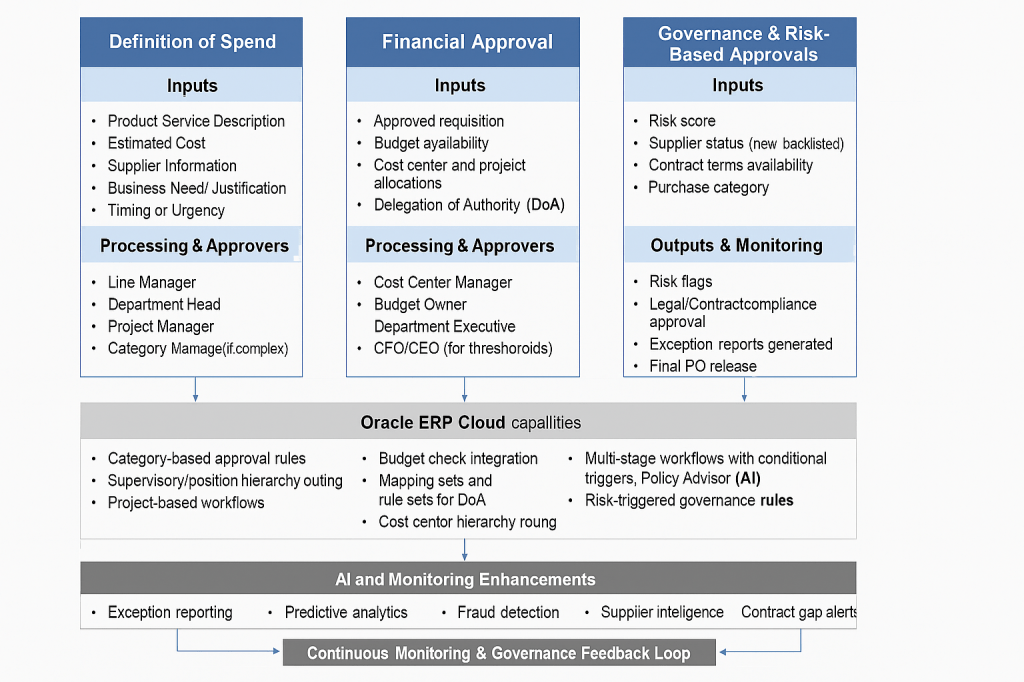
Definition of Spend – Approving the What, Why, and When
At this stage, the goal is to validate the business need for the purchase. Operational approvers such as department managers, project leads, or supervisors assess:
• Whether the product or service is appropriate
• If the supplier is qualified or preferred
• Whether the price is reasonable
• If the timing of the request aligns with business needs
Some organizations escalate complex or high-value requests to category managers or strategic procurement teams. This can be based on the risk profile, supplier classification, category, nature of the contract or even value.
Considerations
Who should approve operational spend: the business user closest to the requirement, or a centralized procurement authority? Many organizations adopt a hybrid approach depending on the spend category and risk.
What can be done to simplify this process? Allowing systematic linkages to work orders, sales orders or projects wherever possible can make the process more streamlined by providing a built in context.
Can a risk evaluated approach be taken to allow automatic approvals? This can be users where the spend is below a threshold, uses pre approved catalogues, is for low risk categories or with low risk and mature suppliers.
Oracle ERP Cloud Capabilities
- Approval rules can be configured based on item category, requisition value, or sourcing method.
- Supervisory and position-based hierarchies route approvals according to organizational structure.
- Supervisory hierarchies further allow to be controlled based on whether the approval needs to go through specific number of skip level approver or needs to be routed to specific job level (where a job level potentially defines the level of the job role in an organisational / operating model hierarchy)
- Oracle supports project-based approval workflows where project managers or funding approvers validate spend.
- Oracle also allows approvals to be managed based on work order for which the requisition is raised
- Generative AI capabilities in Oracle summarize requisitions and purchase orders to speed up decision-making and highlight exceptions or mismatches.
- Hypothesis – Is there a possible use case where AI agents embedded in the guided journey can help classify risk and update DFFs which can be used to further manage the approvals?
Financial Approval – Validating Budget and Delegation of Authority (DoA)
Financial approvals ensure that the expenditure aligns with budgetary limits and that the approver has the right level of authority.
A transparent, system-enforced delegation of authority matrix helps minimize approval delays and prevent fraud.
Common delegation models include:
- Centralized: Senior executives (e.g., CFO/CEO) approve all high-value purchases.
- Departmental: Department heads or cost center managers approve within defined thresholds.
- Category-based: Designated approvers are assigned for specific spend types such as IT, CapEx, or inventory.
Obviously there are always exceptions to the rule. I have seen multiple scenarios where none of the above apply and there are more ad hoc delegations defined.
Considerations
Organizations must strike a balance between control and agility. Centralized models offer oversight, but decentralized models provide responsiveness.
When designing delegations consider the framework that can align to the organisation’s operating hierarchy than to the operational complexity (since that is addressed in the operational approvals).
Many times delegations are defined based on what is the usual spend in that department or what is the role of the department in the organisations operating model.
This creates complexity in the delegation framework and adds to ongoing operational challenges.
Alternatively separating the operational approvals from delegations allows to define delegations based on clear structures like HR levels and departmental hierarchy than based on departmental complexity and overall spend
The other consideration is setting a higher entry criteria requiring financial delegation. Few scenarios can be
- Given there is an operational approval in place there can be a value threshold which doesn’t require approvals.
- The financial delegation can be applied at the contract level to reduce the need for delegation approvals at the PO for lower value spend on a contract
- Budgets can be a consideration too. If the departmental budgets are already approved based on a financial delegation, if the spend is operationally approved and within budgets then there is a lesser risk in skipping financial delegations.
Oracle ERP Cloud Capabilities
- A common pattern is to use cost centre manager based approval and using the cost centre manager’s supervisor hierarchy-based routing to enable financial approvals at the departmental level.
- If the delegations are leveraged within an employee’s line hierarchy then supervisory and job level based approvals can be used.
- If the delegation is managed based on a position matrix then a position based hierarchy can be used. However an important aspect to keep in mind is that the hierarchy defined within HCM setups that define a position that manages another is not used and a position tree is required. This can add to operational/ maintenance overhead when there are changes in positions. Also there is no upload functionality for position trees and needs manual definition and hence if we are working with a large number of positions this can be challenging
- In 24 C Oracle released a Mapping sets based functionality to allow approvals to be routed based on multiple criteria. This could be based on location, category, department or other attributes in a DFF along with value to route the transaction to a name person. While this is still new, this can be something that might help in those scenarios where DoA is more complex or ad hoc.
- All approvals are logged for auditability, and the system maintains a comprehensive audit trail.
- Additionally we can use systematic checks to see if a transaction is within budgets (if budgetary controls are enabled) and choose to add controls like if the spend is below a threshold and within the associated budget, skip the budgetary approvals.
Governance and Risk-Based Approvals
Beyond operational and financial approvals, additional oversight is needed for risk mitigation and policy compliance. Common governance approvals include:
- Category manager sign-off for strategic or sensitive purchases
- Contract manager approvals to ensure terms are adhered to
- Compliance reviews, especially for new or high-risk suppliers
Some companies introduce risk-based governance even before budget approvals, particularly in regulated industries or high-spend environments.
Oracle ERP Cloud Capabilities
- Multi-participant approval workflows allow configuration of additional review steps based on spend thresholds, suppliers, or risk flags.
- Risk-based triggers can invoke contract, compliance, or legal reviews automatically.
- AI-driven Policy Advisor can provide recommendations on required governance steps based on spend pattern or supplier profile.
- Hypothesis – A possible use case where AI agents can be built to analyse transaction for risk and recommend additional approvers based on organisational policy
Considerations
Governance approvals must be carefully implemented to avoid bottlenecks while still safeguarding compliance.
Balancing Control with Agility
An effective procurement approval framework must be dynamic—adapting to spend value, risk level, and the control environment. Best-in-class systems auto-approve low-risk, catalog-based spend while routing complex or high-risk transactions through enhanced workflows.
Approvals should be calibrated based on:
• Spend thresholds
• Procurement categories
• System-controlled factors like contract compliance or budget status
• Organizational hierarchy and responsibility
Oracle ERP Cloud allows organizations to implement flexible workflows that balance speed and control. However to allow this to happen the overall source to pay process design should consider some key framework elements
- Consider the use of requisition business units. They can support enabling strategic policies specific to business units within your organisation. They also allow security in controlling what categories and contracts are available to which departments
- Maintain and manage supplier data to allow tracking supplier risks. Leverage Supplier Qualification Management and business classifications
- Maintain detailed contract information including risks and key meta data to allow assessing contract risks
- Maintain a clear category structure and leverage category hierarchies to support reporting and approval framework
- Leverage budgetary control where possible to allow better decision making
- Have a clear organisation structures (jobs, positions, cost centres) that reflect the real world organisation structure to allow better system adoption
- Leverage catalogs and smart forms instead of free text non catalog where possible as they can be leveraged in approval workflows
Monitoring, Insights, and Continuous Improvement
Modern procurement doesn’t stop at approvals. Continuous monitoring is essential to refine governance and improve efficiency.
- Exception reporting allows organizations to identify bottlenecks, delays, or policy deviations.
- Predictive analytics can flag potential compliance gaps or approval delays before they escalate.
- Oracle AI Agent Studio can help build custom agents to surface policy violations, identify anomalous approval trends, or monitor supplier risk.
- Fraud prevention is enhanced using AI models that analyze patterns across business units, categories, or spend behaviors.
Oracle’s embedded AI capabilities will continue to expand, offering intelligent insights into procurement workflows and enabling procurement teams to focus on strategic value creation.
Conclusion
What does your procurement approval framework look like? Do you have unique requirements that you find difficult to enable in the system? Do certain categories demand more nuanced governance? Have you implemented hybrid or AI-enhanced models?
Share your thoughts, challenges, or innovative models you’ve seen—comment below or connect to discuss further.

 Transforming Supply Chains